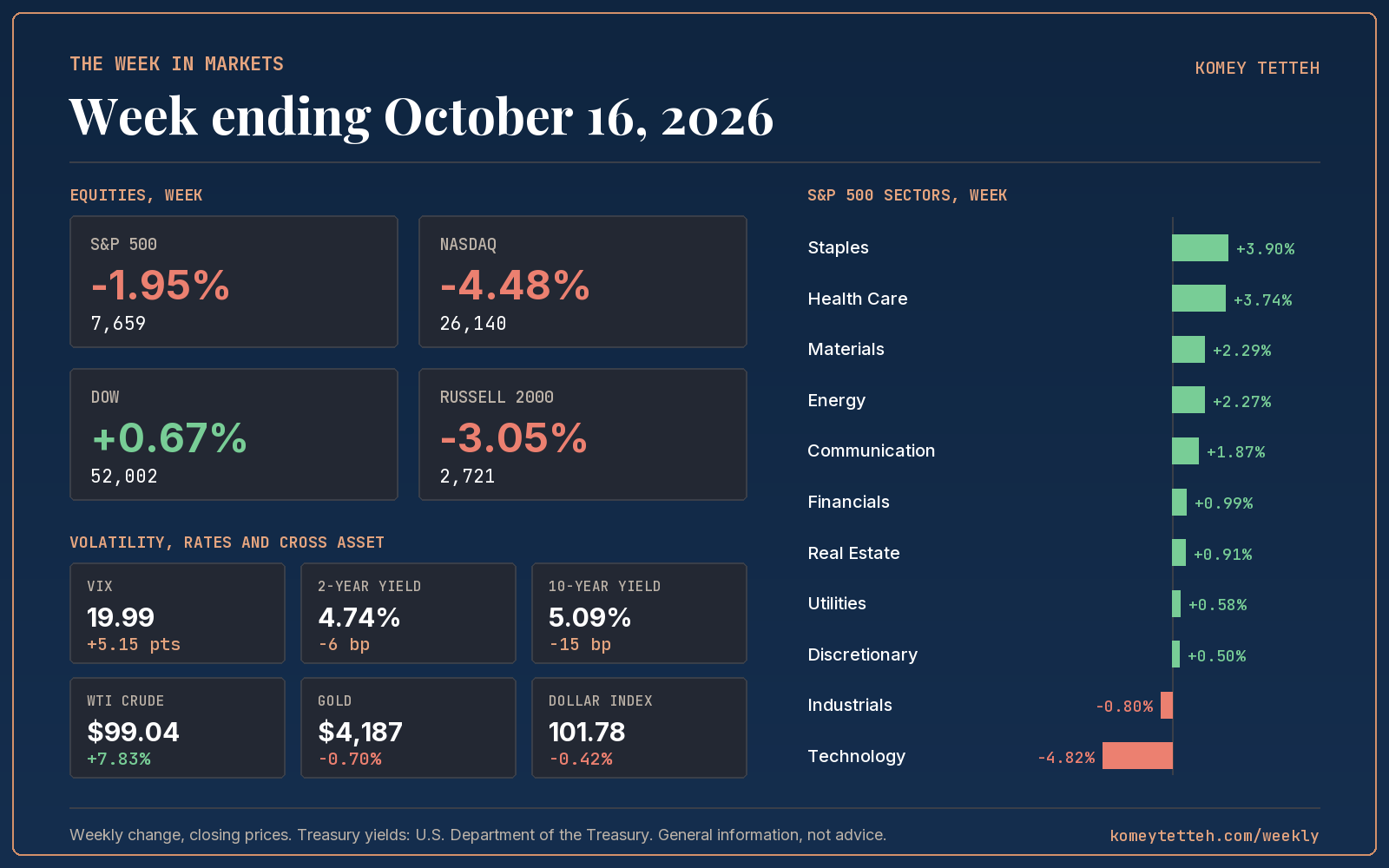
- The S&P 500 fell 1.95% to 7,659 while the Dow Jones gained 0.67% to 52,002, a split that defines the week.
- The Nasdaq Composite dropped 4.48% as Technology led all sectors lower at -4.82%.
- The VIX jumped from 14.84 to 19.99, a rise of roughly 35%.
- The 10-year Treasury yield fell 15 basis points to 5.09% even as inflation data ran hot.
- WTI crude rose 7.83% to $99.04, lifting Energy 2.27% and helping Consumer Staples to the week's best sector gain of 3.90%.
What moved markets
Technology Takes the Fall
Technology closed down 4.82%, dragging the Nasdaq Composite to a 4.48% weekly loss, while the Dow Jones, lighter on technology, gained 0.67%. This was a rotation, not a broad liquidation.
The trigger was a revenue disclosure from a major AI developer that landed well short of figures embedded in mega-cap valuations. Semiconductor and software names tied to AI infrastructure took the brunt, with selling accelerating into the week's final close, a pattern more consistent with positioning unwinding than a change in the growth story.
Hot Inflation Data, Falling Yields
Consumer and producer prices both ran hotter than expected, reviving talk of further tightening. The usual response is higher yields. Instead the 10-year fell 15 basis points to 5.09% and the 30-year fell 17 to 5.43%.
The explanation: the equity selloff generated enough demand for duration to override the inflation signal. Government bonds still act as ballast when growth assets sell off, hot prints or not.
Oil and the Defensive Bid
WTI crude rose 7.83% to $99.04 on ongoing geopolitical tension, lifting Energy 2.27%, while Consumer Staples (+3.90%) and Health Care (+3.74%) topped the sector table as capital rotated toward steadier cash flows and away from AI-exposed names.
Havens Stayed Quiet
Gold slipped 0.70% and the dollar index eased 0.42%, both modest given the scale of the rotation underneath. Neither haven caught a meaningful bid, consistent with capital reallocating within equities and into bonds rather than fleeing risk assets outright.
The volatility read
Options priced this week with real precision. Based on the prior week's VIX close of 14.84, the implied one-week move for the S&P 500 was 2.06%. The index delivered an absolute move of 1.95%, almost exactly matching. On a headline basis, this looks like a quiet week.
It was not. Realised volatility over the five sessions, annualised, came in at just 10.6%, while the high to low range was 2.49%, wider than the close to close move. Technology fell 4.82% while the Dow gained 0.67%, dispersion a single weekly return cannot show. The index-level calm was manufactured by sectors offsetting each other, not an absence of stress.
The clearest signal sits in the VIX itself, which rose from 14.84 to 19.99, most of that move concentrated in the final session. Based on the new close, options imply a weekly move of roughly 2.77% going forward, versus 2.06% priced a week earlier. That is a vol market pricing more uncertainty into the weeks ahead, with a Fed decision on the calendar and the AI financing question still open. It is a statement about forward pricing, not a call on direction.
The scorecard
Equities
| Index | Close | Week | Year to date |
|---|---|---|---|
| S&P 500 | 7,659 | -1.95% | +11.89% |
| Nasdaq Composite | 26,140 | -4.48% | +12.47% |
| Dow Jones Industrial Average | 52,002 | +0.67% | +8.20% |
| Russell 2000 | 2,721 | -3.05% | +9.65% |
Volatility, rates and cross asset
| Market | Close | Week |
|---|---|---|
| VIX | 19.99 | +5.15 pts |
| 2-year Treasury | 4.74% | -6 bp |
| 10-year Treasury | 5.09% | -15 bp |
| 30-year Treasury | 5.43% | -17 bp |
| WTI crude | $99.04 | +7.83% |
| Gold | $4,187 | -0.70% |
| US dollar index | 101.78 | -0.42% |
S&P 500 sectors
| Sector | Week | Year to date |
|---|---|---|
| Consumer Staples | +3.90% | +11.59% |
| Health Care | +3.74% | +14.46% |
| Materials | +2.29% | +11.49% |
| Energy | +2.27% | +48.87% |
| Communication Services | +1.87% | -4.49% |
| Financials | +0.99% | +0.91% |
| Real Estate | +0.91% | +4.06% |
| Utilities | +0.58% | -2.44% |
| Consumer Discretionary | +0.50% | -5.02% |
| Industrials | -0.80% | +8.23% |
| Technology | -4.82% | +31.41% |
Volatility lens
| Measure | Value |
|---|---|
| Implied one-week move at the start of the week | 2.06% |
| Actual S&P 500 move, absolute | 1.95% |
| Actual as a multiple of implied | 0.95x |
| Realised volatility, annualised, 5 sessions | 10.6% |
| S&P 500 high to low range | 2.49% |
The week ahead
- Monday, October 19Federal Reserve blackout period continuesFed officials stay out of public view ahead of the October 27 to 28 meeting, so any volatility this week plays out without policy signaling to lean on.
- Thursday, October 22Weekly initial jobless claimsA higher reading would add to the case the labor market is cooling into a live Fed debate.
- Friday, October 23Preliminary October PMI readingsFlash data gives the first read on growth momentum after a week dominated by inflation and AI-related selling.
Common questions
Why did technology stocks fall so much while the Dow rose?
Technology fell 4.82% while the Dow Jones, which carries less technology weight, gained 0.67%. A revenue disclosure from a major AI developer fell short of what had been priced into mega-cap valuations, concentrating the selling in semiconductor and software names.
Why did Treasury yields fall even though inflation data came in hot?
Hot consumer and producer price data would normally push yields higher. Instead the 10-year fell 15 basis points to 5.09%, because the equity selloff drove enough demand for government bonds to override the inflation signal.
What does the jump in the VIX mean going forward?
The VIX rose from 14.84 to 19.99 over the week. Based on that close, options now imply a weekly move of roughly 2.77%, up from 2.06% a week earlier, reflecting more uncertainty priced into the weeks ahead rather than a forecast of direction.
Index, sector, commodity and currency figures are compiled from public closing prices. Treasury yields are from the U.S. Department of the Treasury daily par yield curve. The implied one-week move is the VIX close before the week began divided by the square root of 52, a common approximation. Commentary by Komey Tetteh.