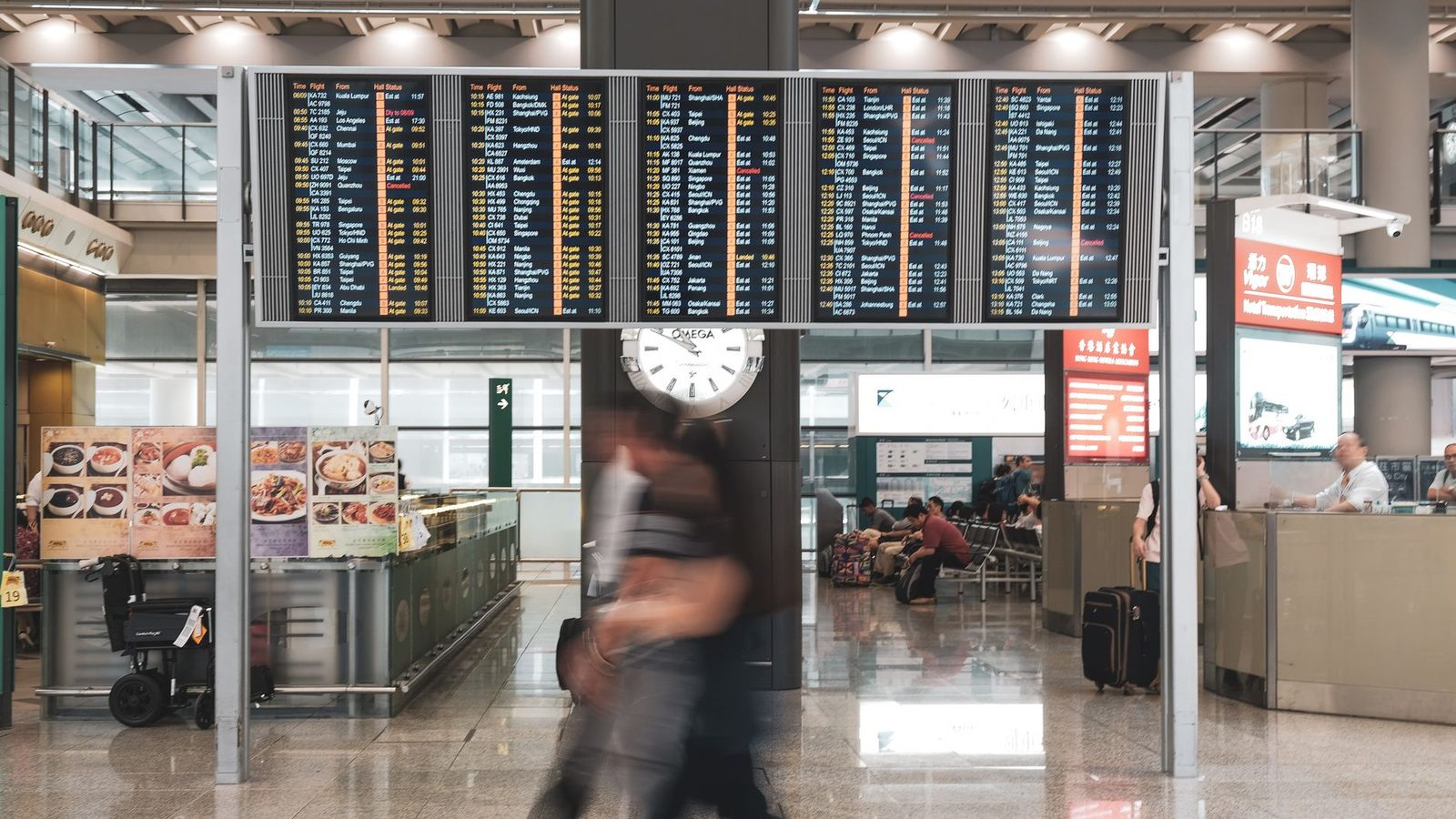
A travel company just told you, in its own numbers, where the next inflation surprise is sitting. Booking Holdings reported third-quarter adjusted earnings per share of $4.66, ahead of the roughly $4.49 to $4.50 analysts expected, with gross bookings up 10% to $54.5 billion and room nights up 7% to 345 million. GAAP revenue fell 1% only because the company booked a $900 million legal charge tied to a Federal Trade Commission matter; adjusted revenue rose 9%. None of that moved the stock. The guidance did.
Booking guided fourth-quarter room night growth to just 1% to 3%, a sharp step down from the 7% it just delivered, and fourth-quarter adjusted EBITDA growth to about flat. Management pointed to softer international travel late in the third quarter, disruptions to Middle East travel tied to an ongoing conflict, elevated airfares, and localized unrest in parts of Europe. Shares fell roughly 1% to 2% after hours, extending a decline that has left the stock around 27% lower on the year and hovering just above a 52-week low near $150.
The mechanism: airfares are the transmission belt
This is not a demand collapse. It is a cost and capacity story moving through a booking platform before it shows up anywhere else in the travel chain. Airlines reduce capacity on disrupted routes, fares rise to clear the remaining seats, and an online travel agent sees the effect immediately in average transaction prices and in traveler hesitation at the point of booking. Booking's own guidance frames the hit as roughly two percentage points off both room nights and gross bookings growth, directly attributable to the conflict's indirect effects rather than a broad pullback in travel appetite. Domestic travel, which does not route through contested airspace or elevated long-haul fares, stayed resilient. That split is the tell: this is a route-specific, cost-driven disruption, not a consumer retrenchment.
Other online travel names fell in sympathy, with Expedia and Airbnb shares also declining after Booking's results. That is the second leg of the transmission: a single company's guidance becomes a sector repricing because the exposure, Middle East routing, airfare inflation, and European travel disruption, is shared across the group, not unique to one balance sheet.
The second-order effect: this is a dispersion story, not an index story
This disruption is being absorbed in single-name volatility, not in broad market volatility. A $900 million charge and a guided deceleration from 7% to a 1% to 3% growth range are large, specific, idiosyncratic shocks. They move the implied volatility surface on travel names and their sector peers. They do not move the volatility surface on the index that contains them, because the index absorbs idiosyncratic shocks through diversification almost by construction. When travel-sector vol rises while index vol stays contained, that gap is not noise. It is a signal that the risk is concentrated, not systemic, and that correlation between travel names and the broader index is falling even as correlation within the travel group itself rises. That is a textbook dispersion signal, and it is visible in the options chain before it is visible in any earnings call transcript.
The honest counter-case: if the Middle East disruption and the airfare spike broaden into a genuine demand shock, perhaps through sustained jet fuel cost pass-through into airline pricing power, or through a wider pullback in discretionary consumer spending, then this stops being a travel-sector story and becomes a consumer-spending story that does belong in index-level volatility. Booking's guidance assumes the disruption persists through year end but does not widen. If that assumption breaks, the dispersion thesis breaks with it.
What we are watching now is whether airfare levels normalize or keep climbing into the holiday booking window, and whether room night growth for the quarter lands at the low or high end of that guided range. Either answer will show up in the travel-sector vol surface before it shows up in a press release. I'm Komey Tetteh, and the question worth asking is not whether Booking's quarter was good. It was. The question is whether the cost shock sitting inside its guidance is still being priced as a single-stock problem when it is, in fact, a route and capacity problem shared across an entire sector.
Common questions
Why did Booking Holdings stock fall after earnings?
Booking beat third-quarter adjusted earnings estimates but guided fourth-quarter room night growth down to 1% to 3%, a sharp deceleration from the 7% growth delivered in the third quarter. Shares fell roughly 1% to 2% in after-hours trading as the guidance, not the quarter itself, became the focus.
What caused Booking Holdings to cut its outlook?
Management cited softer international travel trends toward the end of the third quarter, disruptions to travel to and from the Middle East tied to an ongoing conflict, elevated airfares, and localized unrest in some European cities. Domestic travel demand was described as resilient.
What was the $900 million charge in Booking's results?
Booking recorded a $900 million legal charge related to a Federal Trade Commission matter, which pushed GAAP revenue down 1% year over year even as adjusted revenue, which excludes the charge, rose 9%.
Did other travel stocks fall with Booking?
Yes. Shares of other online travel platforms, including Expedia and Airbnb, declined in sympathy after Booking's results, reflecting shared exposure to the same airfare and geopolitical disruption factors cited in Booking's guidance.
Is Booking Holdings' slowdown a demand problem or a cost problem?
The company's own guidance frames it primarily as a disruption problem: elevated airfares and reduced capacity on certain routes rather than a collapse in underlying travel appetite. Adjusted EBITDA growth for the fourth quarter is guided to be about flat, which points to margin pressure from costs more than a drop in bookings volume.
What should investors watch next with Booking Holdings?
The next read is whether room night growth in the fourth quarter comes in at the low or high end of the 1% to 3% guided range, and whether airfare levels and Middle East related disruptions persist or fade as the company's guidance assumes they will through year end.