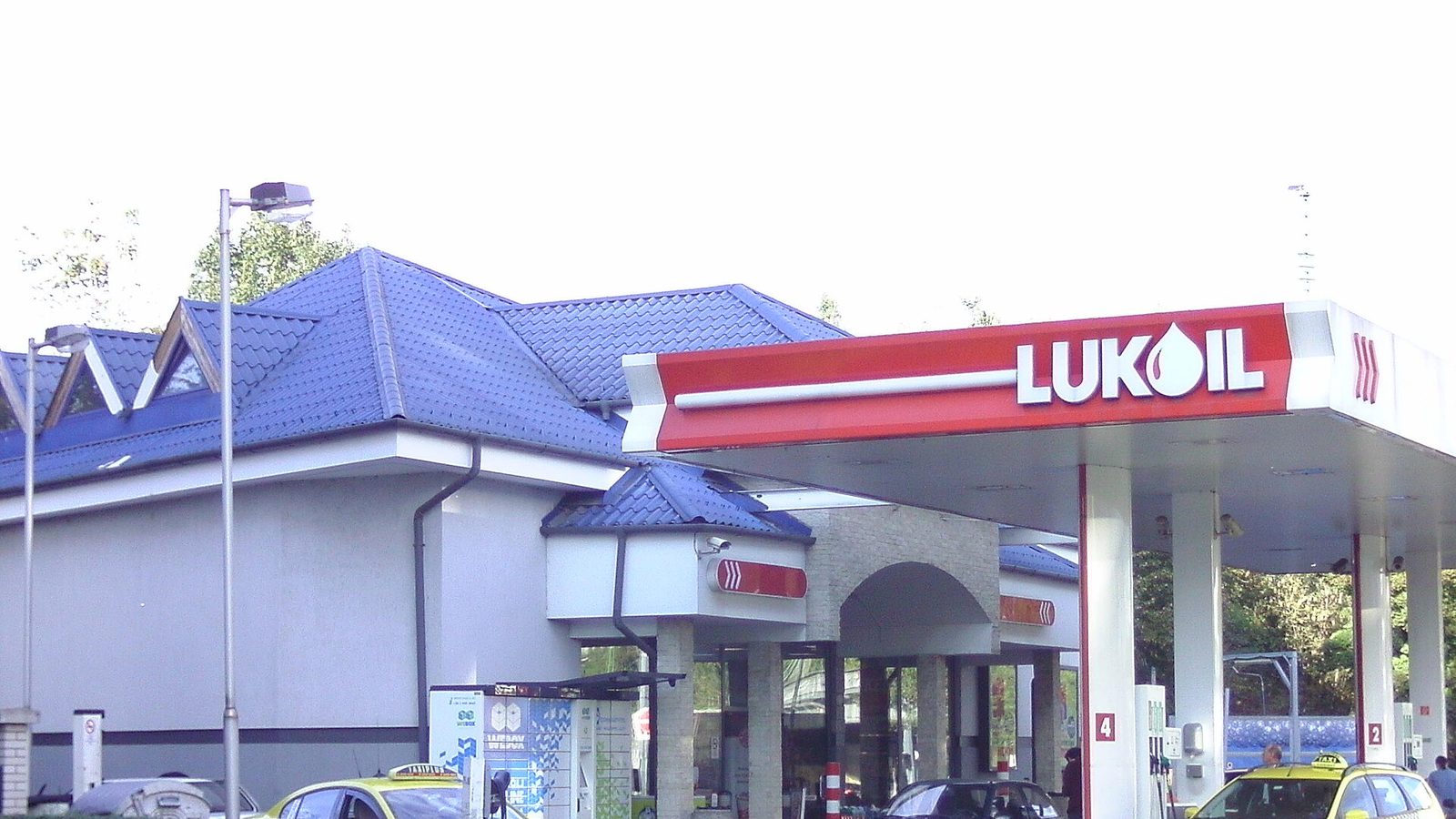
Everyone is reading this as a franchise dispute. It is not. It is a court document showing, in granular detail, exactly how a sanctioned company pushes a revenue shortfall down the chain until it lands on the smallest, least diversified counterparty it has.
The facts are narrow. Owners of almost 30 Lukoil-branded stations across Pennsylvania and New Jersey are suing the company, and a New Jersey judge just refused to let Lukoil out of it. The owners of almost 30 Lukoil PJSC filling stations in Pennsylvania and New Jersey can proceed with a lawsuit accusing the Russian oil giant of overcharging franchisees. Lukoil's motion to dismiss the lawsuit was rejected by New Jersey state court Judge Douglas H. Hurd in Trenton on Friday. The judge didn't give any reasons for his ruling in a brief order.
Read the actual complaint and the headline undersells it. The complaint, filed by 20 New Jersey and 9 Pennsylvania franchisees, says Lukoil set gasoline prices too high to make up for revenue lost to U.S. sanctions, even as unremitting Ukrainian drone attacks hobbled its domestic operations. Owners claim millions in losses from "economic coercion," plus being forced to operate during "demonstrably unprofitable" hours, surprise bills for superfluous maintenance, and withheld funds for essential repairs. That is not a pricing dispute. That is a cash extraction model, applied to the party in the chain with the least ability to walk away.
The mechanism: sanctions do not stop at the border, they cascade down the balance sheet
Consensus treats sanctions as a top-of-the-funnel story: export volumes, the crude discount, refining capacity taken offline. That framing misses where the cost actually lands first. A sanctioned company does not absorb a revenue shock evenly. It protects the obligations it cannot avoid, the ones with legal teeth and external enforcement, and it compresses the ones it can still control internally. A captive franchise network supplied under a single brand, with no real ability to re-source fuel overnight, is exactly that kind of internal lever. Zone pricing is not new to Lukoil's US operation; station owners have fought it for well over a decade. What changed is the justification. The lawsuit alleges the pricing was explicitly used to backfill a sanctions-driven hole, not just to maximize margin by territory. That is the difference between an ordinary commercial dispute and a documented transmission channel.
This matters because the sanctions themselves are forcing a much larger restructuring in parallel. Lukoil agreed to sell most of its international assets to private equity giant Carlyle as U.S. sanctions force the Russian oil major to unwind its overseas operations. Carlyle Group has agreed to buy most of Lukoil's roughly 22 billion dollars worth of foreign assets, which Russia's second-largest oil company is forced to sell because of US sanctions. The retail network, including the mid-Atlantic stations in this suit, sits inside that broader unwind. Lukoil has already booked the damage internally: the company reported an impairment loss writing off its international investment entirely, a figure running into the trillions of rubles.
The second-order effect nobody is pricing
The market's attention is on whether the Carlyle transaction closes and on what happens to the sanctions license deadline that governs it. That is the wrong layer to watch. The real second-order effect is that this litigation is now a liability sitting inside the exact asset pool being transferred. A buyer doing diligence on a distressed, sanctioned seller under a hard regulatory deadline does not get the luxury of a clean balance sheet. Litigation like this gets priced through indemnities, escrow holdbacks, and extended closing conditions, all of which lengthen the timeline and widen the range of outcomes on execution. Forced sellers under sanctions pressure do not negotiate from strength, and buyers know it. Every unresolved legal claim against the operating entity becomes leverage for the buyer to reprice or delay, which is exactly the kind of event-path uncertainty that shows up as elevated implied volatility in adjacent names long before it appears in a headline number.
There is a second layer too, more structural. Litigation filed by small operators, built on internal evidence of economic coercion, is a far better early read on corporate stress than aggregate trade data. By the time a sanctions regime's damage is visible in national export statistics, it has already worked its way through every weaker counterparty underneath it. Franchisee lawsuits, wage disputes, and vendor non-payment claims are the canary. The crude price spread is the smoke alarm that goes off afterward.
The honest counter-case
None of this means the lawsuit wins on the merits, or that it has any bearing on Lukoil's equity, which most investors cannot access in any case given the sanctions regime. A motion to dismiss failing is a low bar; it does not validate the underlying claims, and Judge Hurd gave no reasoning that would let anyone forecast the eventual outcome. It is also possible the Carlyle transaction closes on schedule with this litigation walled off as an immaterial legacy liability that the buyer simply prices around. Sometimes a lawsuit really is just a lawsuit.
What I am watching next is whether the indemnity structure on the Carlyle deal becomes public, because that is where the market will see, in dollar terms, how much this kind of litigation actually costs a forced seller. Our delta-neutral book does not take a view on Lukoil directly, it cannot. But the pattern here, sanctions stress surfacing first at the smallest node in a corporate chain, is the kind of signal that shows up in tail pricing across energy-adjacent names well before it is in anyone's earnings model. Komey Tetteh has watched this sequence before: the headline event is never where the repricing starts. Ask yourself where else in your portfolio the smallest counterparty is quietly absorbing a shock the balance sheet has not admitted to yet.
Common questions
What did the New Jersey judge actually rule in the Lukoil case?
Judge Douglas H. Hurd of the New Jersey state court in Trenton denied Lukoil's motion to dismiss a lawsuit brought by franchisees, allowing the case to proceed. The order was brief and did not state the judge's reasoning, but it keeps the franchisees' claims alive rather than ending the case.
Who is suing Lukoil and what are they claiming?
The plaintiffs are 20 New Jersey and 9 Pennsylvania operators of Lukoil-branded filling stations. They allege Lukoil raised wholesale fuel prices to recoup revenue lost to U.S. sanctions, forced them to operate during unprofitable hours, sent surprise maintenance bills, and withheld funds needed for essential repairs.
Why are there US sanctions on Lukoil?
The United States announced sanctions targeting Lukoil and Rosneft in October 2025. The measures were tied to a lack of progress toward a peace process regarding the war in Ukraine, and they forced Lukoil to begin unwinding much of its overseas business.
What is happening to Lukoil's international assets?
In January 2026, Lukoil agreed to sell most of its foreign assets, held through a unit called Lukoil International, to private equity firm Carlyle in a deal analysts valued at roughly 22 billion dollars. The assets include upstream fields, refineries in Bulgaria and Romania, and retail station networks, and the sale still required approval from U.S. sanctions regulators.
Does this lawsuit affect Lukoil's stock price or US investors directly?
Lukoil is a sanctioned Russian company without a standard US equity listing available to most investors, so the case is not a stock-picking event. Its relevance is as a readable signal of how sanctions stress moves through a corporate structure before it shows up in headline commodity or earnings data.
What is zone pricing and why does it matter here?
Zone pricing is a practice where a fuel supplier charges different wholesale prices to franchisees in different geographic areas based on what the local market will bear rather than a uniform cost-plus formula. Lukoil franchisees have objected to the practice for over a decade, and the current suit ties it directly to the company's post sanctions revenue shortfall.