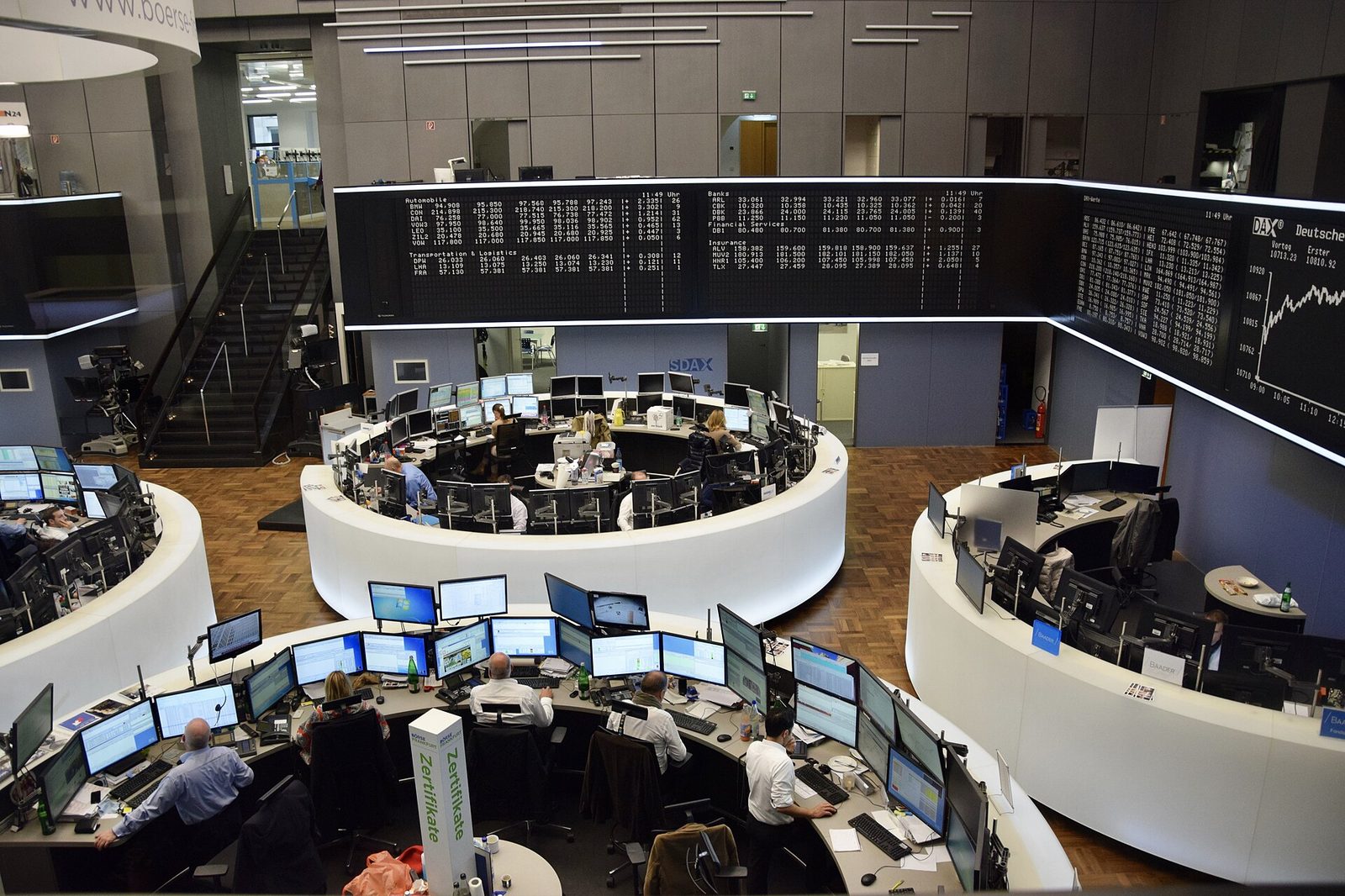
Europe is not having a stock market renaissance. Europe is hosting one.
Bloomberg's weekend coverage caught the buzz building around European equity markets, and the numbers underneath the story are real. The Stoxx Europe 600 closed at a record 656.86 in early August and is up roughly 10 percent on the year. Germany's DAX traded above 26,100 for the first time. France's CAC 40 set a record near 8,700. Italy's FTSE MIB printed 53,540. National benchmarks across the region are at all time highs at once, which is the kind of thing that gets described as broad.
It is not broad. It is the most concentrated European rally in years, and the concentration is imported.
What is actually driving the index
Strip the index back to what moved it and you find semiconductors. France's Soitec, a maker of engineered substrates almost nobody outside the sector could have named two years ago, rose 414.5 percent between the start of 2026 and 5 August, the best performing constituent in the entire Stoxx 600. ASML, Infineon and STMicroelectronics have carried disproportionate weight. Luxury is absent from the leaderboard. Pharma is absent. Banks have had a strong year and have still been left behind by the chip complex.
Every one of those leaders is a derivative of American and Asian hyperscaler capital expenditure. Their order books are set in board meetings in Santa Clara and Redmond, not in Frankfurt or Milan. The Stoxx 600 has quietly become a euro denominated expression of the global AI buildout with European ballast attached.
The mechanism: index flow amplifies the thing it is supposed to diversify
The money arriving in Europe is not stock picking money. European ETFs took in 48.2 billion euros in January and 48.7 billion euros in February, back to back monthly records. EPFR tracked roughly 10 billion dollars a week into European equity funds during that surge. Global equity funds have run week after week of inflows through the summer while US funds bled.
Index money buys the index. The index is market capitalisation weighted. The names that have already tripled take the largest share of every incremental euro. So the flow that arrives because Europe looks cheap and diversified relative to the S&P 500 is mechanically deployed into the least cheap and least diversified part of the European market. The allocator's stated reason for buying is undermined by the vehicle used to buy it.
This is not a criticism of passive investing. It is a description of what happens to a factor structure when the marginal buyer is indifferent to composition. The Stoxx 600 stopped being a diversified basket of European cash flows some time this year. Almost nothing has been repriced to reflect that.
The second-order effect: European index volatility is now mispriced against its own contents
At the end of June, EURO STOXX 50 implied volatility sat at 13.68 against 30 day realised volatility of 14.01. The DAX showed the same shape, 13.88 implied against 14.25 realised. Both were running a negative volatility risk premium, meaning options were priced below what the underlying was actually delivering. Stoxx Europe 600 implied volatility was 11.33. Skew was flat and range bound.
Sit with that. Index concentration at a multi-year high. Index implied volatility near the floor of its distribution. Those two facts are not compatible.
Index volatility is a function of single name volatility and the correlation between names. When a handful of high beta, high multiple, globally cyclical stocks dominate index weight, the effective correlation of the index rises whether or not the trailing correlation matrix says so yet. The diversification that historically suppressed European index volatility relative to its constituents is thinner than the option market is charging for. Traders are being quoted a price built on the index that existed in 2019.
The market is pricing European index volatility off a diversified basket. It is trading a semiconductor cycle in a euro wrapper. That gap is the trade nobody is discussing.
The consequence lands on hedgers. A pension fund buying Stoxx 600 or DAX downside believes it owns protection against European risk: French fiscal politics, energy, a policy error. What it actually owns is convexity on the AI capital expenditure cycle. It pays properly only when the thing that goes wrong is American. Correlation of the hedge to the risk being hedged has fallen. The invoice has not.
The reflexive loop underneath it
A second transmission is going unjoined. Nearly half of Stoxx Europe 600 revenue, on a weighted average basis, is generated outside Europe, and foreign revenue exposure correlates with size, so it clusters precisely in the exporters leading this rally.
The euro traded around 1.155 against the dollar in the first week of August, a seven week high. Some of that is Federal Reserve expectations. Some of it is the unhedged portion of the same allocation flow. Buying European equities without hedging the currency is, in part, buying the euro.
So the flow that lifts the index also bids the currency, and the currency translates the foreign earnings of the exporters dominating that index at a worse rate. The rally taxes its own earnings base. The loop operates with a reporting lag of one to two quarters, which is exactly long enough for everyone to forget what caused it.
Add the policy layer. The European Central Bank raised its key rate by 25 basis points in June, its first increase in three years, then held in July. Long duration growth equities are being repriced upward at the same moment the European discount rate is going up. That combination is sustainable only if the earnings delivery is real.
Where I would be wrong
European earnings this season have been genuinely strong, and not only at the top of the index. If AI capital expenditure is a decade long infrastructure cycle rather than a two year order surge, then concentration is not a distortion, it is correct capital allocation, and the US market has spent three years proving a narrow index can compound far longer than sceptics can stay solvent. A hiking ECB with a steeper curve is a direct positive for bank net interest income, which broadens the earnings base rather than narrowing it. German fiscal expansion is appropriation backed, not a sentiment cycle. And 1.155 on the euro is not extreme by any historical measure, while hedge ratios among cross border allocators have risen, muting the translation drag.
If all of that holds, the index is not fragile. It is early.
What I am watching
The spread between Stoxx 600 index implied volatility and the volatility of its largest semiconductor constituents, because that is where the mispricing lives and where it resolves. Whether index implied volatility rises alongside concentration or keeps ignoring it. Breadth on the next record high. The euro through 1.16. This is the kind of setup a delta-neutral book is built to express, because the view is about the relationship between prices, not the direction of any of them.
One question. If you own a European equity index today, can you say precisely which macro risk you own, and is it the one you think you are being paid for?
Komey Tetteh is a Portfolio Manager. This piece is general information and market commentary only. It is not financial advice, not a recommendation, and not an offer to buy or sell any security. The original report referenced is available at Bloomberg.